Petrified Forest National Park Animal Page

Welcome to the Petrified Forest National Park Animal Information Page
It is our intent to provide information that will be timely and of assistance in planning a trip, vacation or obtaining data about this park

-SPONSORED LINKS-
Arizona Lodging
Arizona Hotels
Arizona Maps
Arizona Camping
Arizona Weather
Arizona Vacation Rentals
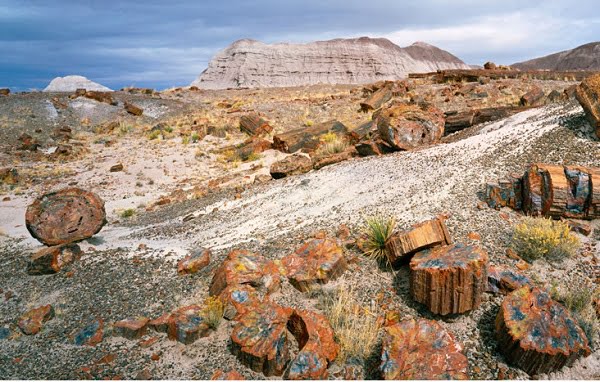
Crystal Forest

Sponsored National Park Search

Crystal Forest - Corel ©

Petrified Forest National Park Animal Information

  • Amphibians
  • Dinosaurs
  • Lizards
  • Mammal Guide
  • Ravens
  • Reptiles

  • 
    

    Amphibians

    Can you imagine living underground for 9 months of the year and not eating, drinking, or defecating? An amazing group of animals living in Petrified Forest National Park do just that - amphibians. It’s hard to imagine that in this dry, high desert region, animals that require consistent moisture could thrive. Three hundred and fifty million years ago the first fish-like amphibian hauled itself out of the sea; by the time dinosaurs appeared amphibians were flourishing. Today they are still among the most successful groups of animals. Why have they survived and adapted to such varied environments worldwide? Permeable skin!

    Permeable skin is what allows amphibians to live in Petrified Forest. Amphibians do not drink; instead, they absorb water through their skins. Most terrestrial amphibians have an area of skin called the pelvic patch. This thin patch has a network of capillaries that absorb moisture from the environment. Spadefoot toads, residents of the park, absorb water from the soil in which they hibernate. Although permeable skin allows for water absorption, it provides little barrier to evaporation. This causes amphibians’ water balance to be in constant flux. Evaporative water loss also results in loss of body temperature. This is why you often see amphibians on warm pavement in the evening. It is not an easy life for amphibians in this dry grassland. Behavioral and physiological mechanisms that shape their daily life make it possible for them to survive.

    Tiger salamanders are the only salamander species known in Arizona. From 3-7 inches long, they have a gray, olive or black background color with yellow or white bars mottling the back. They are found in park grassland near major drainages. Most of their year is spent underground. Emerging in the spring and early summer they breed in rivers and temporary pools.

    Seldom seen, Woodhouse's toads are identified by a thick white dorsal stripe dividing its back and at a prominent cranial crest (bony ridge behind the eye). It has a gray, yellow-brown or olive background broken by dark spots with red or orange centers. Anywhere from 2 to 6 inches long, they are the largest toads in the park. They frequent grasslands, stream or wash corridors and developed areas.

    Red-spotted toads sport vivid red or orange warts on a light gray, olive or brown background. This small toad, is only 1.5 to 3.5 inches in length. Rocky areas near streams, canyons and floodplains are preferred habitats. It is most active during the rainy season from July through September.

    The Great Plains toad, measuring 2 to 5 inches in length, is the most common toad in the park. It is greenish overall with symmetrically paired, pale-edged dark blotches down its back. A dark vocal sac distinguishes males. Grasslands are preferred.

    Short, round and squat, the New Mexico spadefoot is the most common spadefoot in the park. All spadefoots are distinguished by a thick spade-like structure on their hind feet used to dig their burrows. Like most amphibians, they spend most of the year underground. The New Mexico spadefoot is gray or tan in color with red spots.

    New Mexico and Plains spadefoots are very difficult to tell apart. Both species are found throughout the park and are often sighted together. While similar in size and color, the Plains Spadefoot has a larger head and eyes with a small bony boss (bump) between its eyes.

    Couch's is the least common and largest of the spadefoots. Bright greenish yellow to brown in color with dark gray-brown mottling, they blend with their preferred habitat, grass and shrub-lands. Because they are active primarily during the short monsoon season, accelerated development enables tadpoles to complete their growth before water sources dry up.

    Although amphibians have been successful for millions of years, today they are in trouble. Biologists have noted dramatic declines in populations of species worldwide. What is causing these declines? No one knows for sure, but it is thought that it may be a sign of global environmental degradation. For many populations, the causes include habitat loss, such as the destruction of wetlands, pesticide contamination, heavy metal poisoning, and predation and competition from introduced species. Natural population fluctuations may explain the decline of some populations. However, scientists have ruled out natural causes as the only explanation for the overall problem as declines are happening in many species simultaneously around the world. Human actions are the primary cause of to these declines.


    Dinosaurs and Triassic Reptiles

    During the Late Triassic Period, (225 million years ago) Petrified Forest National Park was a vast floodplain crossed by many streams. Crocodile-like reptiles, giant fish-eating amphibians and small dinosaurs lived among a variety of ferns, cycads, and other plants and animals that are known only from fossils today. Petrified Forest National Park is one of the world's greatest storehouses of knowledge about life on earth when the "Age of the Dinosaurs" was just beginning.

    Exhibits at Rainbow Forest Museum include freestanding casts of some Triassic Period reptiles and displays on early dinosaurs.

    Placerias was a large, bulky plant-eating reptile weighing up to 2 tons. It had strong but toothless jaws and probably lived on a diet of tough, fibrous plants. The large tusks may have been used to dig up roots and tubers for food.

    Belonging to a group known as phytosaurs, fossils indicate that some individuals reached 30 feet in length. They lived a crocodile-like life in the rivers and lakes preying on fish and smaller animals. Bony plates protected the body and tail.

    Desmatosuchas was a 16-foot long, plant-eating reptile that sported a long, pig like snout and looked like an overgrown armadillo. A bony carapace (shell) covered the long narrow body and large spikes on its sides were probably used for defense.

    Chindesaurus was an early primitive dinosaur. It was 8 to 12 feet long from head to tail, with sharp, sickle-shaped teeth indicating a meat diet. Lightly built with exceptionally long hind legs, it may have been one of the fastest land-dwellers in this area. This speed helped it overtake its prey.

    Coelophysis was one of the early known dinosaurs. It was about 8 feet long and could weigh 50 pounds. Long slender jaws lined with sharp, flattened teeth indicate it was carnivorous. This agile animal probably walked on its hind limbs and used its forelimbs to catch and hold prey. Large eye sockets suggest keen eyesight.

    This ferocious looking reptile was a large land-dwelling predator. It moved in a dinosaur-like way with its legs tucked under its body not sprawled out to the side like most reptiles. A medium sized animal was about 13 feet long.

    The Park Needs Your Help!

    Like pieces of a puzzle, fossils have long provided clues to the past. Paleontologists are slowly reconstructing the Triassic ecosystem in Petrified Forest National Park by piecing together fossil records. The scientific and educational value of a fossil can only be interpreted when it is properly documented and studied. The displacement of a specimen from its surroundings reduces it to a mere curiosity. Help us by not disturbing any fossils you find during your visit. Report your fossil discoveries to any uniformed employee.


    Lizards

    While strolling along Giant Logs Trail at Petrified Forest National Park, a lizard with a green body, bright yellow head and two black neck bands catches your eye. You stop. Fascinated, you watch this nimble creature catch and devour insects as it hops from rock to rock. Even though you approach cautiously, the lizard rises on its hind legs and speeds away. With forelimbs and tail raised, it resembles a miniature dinosaur. Could it be related to the small dinosaurs that roamed the park 225 million years ago?

    Your patient waiting is rewarded when the collared lizard finally reappears. At the same moment, a flickering shadow overhead alerts the lizard. Looking up you marvel at the massive wingspan of a golden eagle. Suddenly, with talons extended, the eagle dives for the collared lizard, only to have it escape under a petrified log. Moving toward the lizard's hiding place, a movement catches your eye. Reflexively you step aside as a 3-foot long snake slinks away carrying a familiar green and yellowish object in its mouth. Unfortunately, the collared lizard wasn't swift enough to evade both predators.

    A vibrating sound startles you and you quickly dance backward. Fortunately a park ranger is approaching so you can show her the snake with the partially eaten lunch in its mouth and ask some questions about the animals you have been observing.

    The ranger explains that the snake is a nonpoisonous gopher snake. The snake's coloring is similar to a rattlesnake, and when threatened, it displays an array of defensive actions that mimic rattlesnake sounds and motions. The ranger also pointed out that the snake could dislocate its jaws allowing it to swallow prey four times its size. Gopher snakes are the most common of the eight snake species in the park. They feed on insects, lizards, worms, mice, and rabbits. A mature gopher snake may grow to be an impressive 6 feet long. Courtship and mating occurs after snakes emerge from hibernation, the eggs are laid in late spring, and hatch in late summer. The babies grow rapidly and mature after two or three years.

    As you observed, collared lizards are found in rocky areas and feed on insects and smaller lizards, the ranger explained. They identify prey by movement, and grasp it with lightning speed. These swift-footed lizards have been clocked at 15 miles per hour. Pretty but pugnacious, they'll bite hard when captured. Unlike other lizard species, they don't readily shed their tail when caught.

    At the end of the trail you enter Rainbow Forest Museum, home to the skeletal models of giant reptiles and amphibians that called the park home 225 million years ago. A ranger in the museum explains that prehistoric creatures were cold-blooded, just as modern reptiles and amphibians. That means their body temperature remains about the same as their environment. Just as the ancient giants adapted to their Triassic environment, so have the modern reptiles and amphibians to the high desert at Petrified Forest National Park.

    Even though many people are frightened of reptiles and amphibians, their presence helps scientists understand the environmental health of an area. For example, the ranger said, local declines in adult amphibians could indicate the loss of wetlands or the presence of toxic pesticides, herbicides, acidification and other human-induced stresses that affect their reproductive cycles. The resource management staff is monitoring reptile and amphibian populations in the park. Species diversity and population levels of these organisms indicate that Petrified Forest's environment is healthy.

    Petrified Forest National Park is one of the few recovered high desert, short grass prairies areas in Arizona. It is a fascinating place where visitors can compare ancient and modern reptiles, and deduce for themselves whether collared lizards are related to the giant reptiles or early dinosaurs that are exhibited in Rainbow Forest Museum.


    Reptiles

    Well adapted to the high desert environment of Petrified Forest National Park, reptiles play an important part in maintaining the health of the ecosystem. Over sixteen varieties of lizards and snakes make Petrified Forest their home. Reptiles occupy a variety of habitats ranging from grasslands to rocky slopes. They consume large quantities of insects, spiders, scorpions, other reptiles and small mammals thereby preventing infestations of any single species. Respecting the entire reptile community helps to preserve this vital link.

    The collared lizard is the largest and most frequently seen lizard in the park because it is found in every habitat. It is easily identifiable by its large head, greenish-blue to greenish-yellow highlights on its back, and a double black neck collar. Not shy, they are often seen sunning themselves on rocks and petrified logs. Don’t be fooled by their harmless appearance; they have very sharp teeth and will bite hard if they feel threatened.

    A lover of grasslands and developed areas, the plateau striped whiptail is a long slender lizard. They have six to seven light stripes down their back, separated by dark brown to black bands, and a long olive-blue or greenish-blue tail. Whiptails are exceptionally fast runners and can be seen darting rapidly from bush to bush to avoid capture. The success of the whiptail in northern Arizona is partially due to their fascinating reproduction process. There are only females in this species. In early summer the females lay three to five unfertilized eggs which hatch to become individuals genetically identical to the mother.

    Confining itself to rocky areas of the park, the side-blotched lizard is seldom seen. Three to four inches long, it is distinguished by black to blue blotches on each side of its chest behind the forelegs. Like many lizards, it has the ability to shed its tail when attacked. The tail will grow back, but does so at a significant cost in energy. This can result in a missed reproductive cycle, sluggish metabolism and loss of status in the lizard community.

    The gopher snake is one of the most commonly seen snakes in the park. They have few habitat preferences and are often seen during the day. They have a cream colored background and belly with black, brown, or red-brown blotches that darken in rings to ward the tail. When disturbed, the gopher snake will sometimes imitate a rattlesnake by hissing loudly, vibrating its tail and striking repeatedly. If you encounter this behavior you are too close. Slowly back away.

    Preferring grasslands and shrub areas, the western rattlesnake is the only poisonous snake found in the park. It can be identified by brownish blotches down its back, triangular shaped head and thick tail usually ending in a rattle. It is often confused with the gopher snake because of similar coloration and behavior. Unlike most other snakes, rattlesnakes bear live young. In some instances the mother will stay with her litter, for a few days to a few weeks after they are born, defending them from predators. If you are fortunate enough to see one, be sure to give it a wide berth, 6 feet or more to respect its personal space.

    The kingsnake is one of the less common snakes in the park, but easy identified. It is the only snake to have alternating black and white, cream, or yellow bands on the back and sides. Their head is small and not very distinctive. It prefers the open grasslands of the park. It is one of the few species that will eat rattlesnakes, apparently, being immune to the venom. If disturbed they will empty their cloacal contents on the unsuspecting victim, so beware.

    The following is a list of reptiles known to occur in the park. Continuing research will undoubtedly identify more species as various park habitats are studied. Help protect this important park ecosystem by observing our reptile inhabitants from a distance.

    Lizards and Snakes
    Name Scientific Name Name Scientific Name
    Collared Lizard Crotaphytus collaris Side-Blotched Lizard Uta stansburiana
    Sagebrush Lizard Sceloporus graciosus Eastern Fence Lizard Sceloporus undulatus
    Short-Horned Lizard Phrynosoma douglassi Lesser Earless Lizard Holbrookia maculata
    Plateau Striped Whiptail Cnemidophorus velox Little Striped Whiptail Cnemidophorus inornatus
    New Mexico Whiptail Cnemidophorus neomexicanus Glossy Snake Pituophis catenifer
    Gopher Snake Pituophis melanoleous Night Snake Hypsiglena torquata
    Striped Whipsnake Masticophis taeniatus Common Kingsnake Lampropeltis getulus
    Milk Snake Lampropeltis triangulum Western Rattlesnake Crotalus viridis


    Mammals Guide

    Habitat - The area where a plant or animal biologically lives is called its habitat. Habitat must include the food, water, shelter and space suitable to an animal's needs. Petrified Forest National Park's habitat is a blend of short grass prairie and high desert, with a climate of extremes and occasional violence. Half of the 8.69 inches of annual precipitation per year arrives via violent thunderstorms in July, August and September. Summer nights are typically in the 50's with daytime temperatures in the 90's. Winter highs are usually in the 40's with lows in the 20's.

    Desert Cottontail - Looking like powder puffs, the white tail of this small rabbit is conspicuous on their mottled grayish-brown bodies. Early morning and dusk are favorite times for the cottontail to nibble on everything from the roots and tops of grasses to herbs or the bark of trees. Three to four litters a year, with four to six young in each litter, are born during warmer months. Unlike hares, babies are born blind and hairless in a cool, underground burrow.

    Kangaroo Rat - Well adapted to a desert environment, the tiny kangaroo rat lives without drinking water. Its fur-lined cheek pouches are used to carry seeds; during digestion of these seeds, complex chemical processes extract enough water for the kangaroo rat's survival.

    Pronghorn - Fastest of all American animals, the pronghorn may reach an amazing 60 miles per hour in short bursts. Smaller than a deer, the pronghorn is characterized by white neck patches and a white rump. Pronghorn do not loose their horns, but shed the outer sheath each year. Both male and females have horns although the male's horns are larger. Traveling in small herds, this native mammal can be seen in the park south of Interstate 40 feeding on sagebrush and grasses.

    Pronghorn are in the family Antilocapra americana. Distinguishing characteristics include: pronged or forked horns, horns present in both sexes, horn sheaths shed and replaced annually and possess numerous scent glands. Three subspecies of Antilocapra americana are present in Arizona. The species that inhabits Petrified Forest National Park is Antilocapra americana americana and exists from central Arizona northward. Antilocapra americana sonoriensis occupies the southwestern corner of the state and Antilocapra americana mexicana occurs in the southeastern corner. Skull size and body stature is the primary difference in these subspecies. Antilocapra americana americana (Petrified Forest species) skull is broader, larger and has an obvious frontal depression and darker coloration, while the skulls of mexicana and sonoriensis are narrower and more delicately structured with no frontal depression. Additionally, the mexicana and sonoriensis species are shorter.

    Pronghorn inhabitant the plains and meadows of short grass from the desert of Southern Arizona to northern high plateau grasslands. They prefer areas of grasses and scattered shrubs with rolling or dissected hills and mesas. Open grassy areas in the park between the Santa Fe Railroad tracks and I-40, the Blue Mesa/Agate Bridge area and the flats south of Rainbow Forest are preferred locales. Because cattle have not grazed the park for many years, the recovered vegetation offers an excellent diet. Plentiful food may be one-reason groups of 30 to 50 animals winter in the park.

    Arizona pronghorn mate in late August and early September with fawns being born in May. (230-240 day gestation period.) Females can be bred when they reach15 to 16 months old. Fawns are capable of some speed and independent activity at birth, and by the third day they are impossible to catch. Recent pronghorn research shows pronghorn fawn survival correlates directly with coyote population. The coyote population in the park is healthy and is the major cause of neonatal fawn loss. Another contributing factor is poor cover to hide the fawns. Dense brush in some areas of Petrified Forest offers excellent concealment from predators.

    Water consumption varies inversely with the quantity and succulence of the plants consumed. When moisture content is 75 percent or more, pronghorns do not drink water, even if available. Under the driest conditions, animals consume about three quarts of water per day, with varying amounts of water consumed between the two extremes. Arizona pronghorn prefer succulent grasses such as alkali sacaton, blue grama grass and even cacti. In winter they browse on saltbush, sagebrush, rabbit brush and yucca.

    The male's skull is larger than females and has a broad black band from their eyes to the snout, a black nose and black neck patch. The doe lacks the black mask and neck patch. Twelve to twenty inch horns adorn the buck's head while the females are 3-4 inches long, seldom longer than her ears.

    The fastest land animal in the Western Hemisphere and among the fastest in the world, pronghorn have been clocked at 70 mph. Speeds of 45 mph are not unusual, and 30 mph is an easy cruising speed. Because it inhabits open terrain, it relies on speed and keen eyesight for safety. Its protruding eyes can detect movement 4 miles away.

    Black Tailed Jackrabbit - Bounding over the prairie on long hind legs, the jackrabbit can cover 12 to 20 feet in a jump. This large, brown, golden eyed hare is most active at dusk and daybreak, but can occasionally be seen along roadsides during the day. Hares are born with fur and well-developed eyesight allowing them to follow their mother shortly after birth. An average litter is 4, with multiple litter born each year.

    White-Tailed Antelope Squirrel - This small ground dwelling squirrel has a brownish coat with a single, narrow white stripe from shoulder to rump. When running, the antelope squirrel flips its tail over its back, flashing the white underside. You may see one perched in bushes or on rock piles.

    Coyote - The coyote resembles a small, rough-coated shepherd dog with a long, frizzled buff-gray and black coat. The desert coyote weighs about 25-30 pounds. The female normally has 1 litter a year, with an average of 6 puppies. Rabbits, ground squirrels, mice and grasshoppers is the usual diet, but he is not fussy and eats carrion and during lean times, seeds, fruits and grasses.

    Gunnison's Prairie Dog - Prairie dogs are social animals living in "towns" that often cover many acres. Within each colony, there is a complicated social structure that includes a communications network involving sight, sound and odor. Gunnison's prairie dog is a chunky rodent weighing up to 2 pounds. They eat short grasses, roots, bulbs and even worms and insects.

    The Gunnison prairie dog is a burrowing member of the order Rodentia, the largest group of mammals in the world. An adult prairie dog is 12 and 16 inches long and weighs between 1.5 and 2.5 pounds. Its white-tipped, hair-covered tail is about one-fourth the animal's total length. Its body is tan to pale brown, with white to buff-white under-parts. Short legs have large feet with well-developed claws, especially the forefeet. Its broad head is rounded with fairly large eyes.

    Five species of prairie dogs live in North America. The smallest species, Gunnison prairie dog, is found in Petrified Forest National Park. Field observations conducted by resource management staff revealed 9 colonies within the park. However, only 4 colonies (all south of Interstate-40) contained viable populations. Anecdotal evidence suggests the vacant colonies were extirpated due to plague, which infected a colony on the main park road North of I-40, in 1994. It appears to have spread north in 1995, decimating two colonies east of the park residential quarters. The largest prairie dog colony is approximately 160 acres an is located in the southwest corner of the park.

    Gunnison prairie dogs live in colonies or "towns" that range in size from one acre to several thousand acres. The largest recorded prairie dog colony was in Texas, and was about 100 miles wide, 250 miles long and contained an estimated 400 million animals. In the late 1800s, some 700 million acres of North American rangeland was inhabited by prairie dogs. Habitat destruction and extensive eradication efforts have reduced the acreage by 90 to 95 percent.

    Areas of short and mid-grass rangeland are the prairie dog's preferred habitat. Prairie dog colonies are most recognizable by the mounds at their burrow entrances. Mounds of excavated soil are cone-shaped and vary from one to three feet in height and three to10 feet in diameter. These mounds serve as lookout points and prevent water from entering the burrows. A colony will typically have 30 to 50 burrow entrances per acre. The animal's burrow system can be quite complex and extensive. Tunnels are generally three to six feet below the surface and about 15 feet long, although burrows have been reported to reach depths of 15 feet. Burrow systems include a chambers near the entrance where the prairie dog can sit and listen for activity above ground, and one or more nest chambers where they sleep and care for their young.

    The fact that prairie dogs live in colonies indicates they are highly social animals. Towns are often divided into "wards" by topographical barriers such as roads, ridges or trees, and are generally five to 10 acres. Although prairie dogs in one ward may see and hear animals of an adjacent ward, movement among wards is unusual. Wards are divided into smaller social units, called "coteries." Each coterie consists of one adult male, one to four adult females, and any offspring less than two years old. Members of one coterie defend their territory from invasion by members of other coteries.

    Prairie dogs are active from sunrise to sunset. During summer they spend one-third to one-half of the daylight hours feeding. Another third is involved in social interactions with colony members, working on burrows and mounds and responding to alarm calls. The remainder of daylight is spent underground, especially during mid-day when temperatures are high. Because prairie dogs have many avian, mammalian, and reptilian enemies, they are always watching for predators. In winter the Gunnison prairie dog stays underground where they remain dormant during cold weather, but they are not true hibernators.

    Gunnison prairie dogs exhibit an elaborate communication system. At least 11 separate calls have been identified, and a variety of postures and displays. Calls range from signals of alarm to "all-clear". Physical contact is another method of communication. Mouth-to-mouth contact is used to identify coterie members from strangers, and grooming among coterie members is common.

    Grasses are the preferred food and generally make up 70-95% of its diet. In the fall when green grass is less available, broadleaf forbs become important. In spring and summer, each prairie dog consumes up to two pounds of vegetation per week. Prairie dogs also eat seeds and insects as they prepare for colder weather.

    In addition, prairie dogs clip, but do not eat the vegetation within its colony. This clipping is probably done to provide an unobstructed view of approaching predators. Over a period of time, clipping, foraging and digging activities can alter the composition of vegetation in the town. Short native grasses like buffalograss and grama grasses are favored when an area is used by prairie dogs for a long period of time.

    A prairie dog reaches sexual maturity after its first winter and has one litter per year. Breeding takes place in March and early April, and a litter of four to six young is born 30 to 35 days later. Young prairie dogs are born hairless, helpless, and with their eyes closed. They remain underground for six weeks then emerge to feed on green vegetation. They reach adult size by fall.

    Although prairie dogs have been known to live eight years in captivity, its life span in the wild is three to four years. In addition to man, prairie dogs face many natural predators. Badgers are the main marauder, but coyotes, weasels, golden eagles, hawks and kit fox enjoy a meal of prairie dog. Bullsnakes and rattlesnakes prey upon young prairie dogs.

    A prairie dog is susceptible to many diseases, the most notable being plague. Plague is an infectious disease transmitted an infected flea bite. Plague can wipe out entire colonies. This disease was known as "black death" in the 1300s when one-third of Europe's human population was lost. Plague can be transmitted to humans through the bite of an infected flea.

    Prairie dog towns are considered a biological oasis because of associated use by other wildlife species. Some feed on prairie dogs, while others use the burrows or habitat. Cottontail rabbits, several species of rodents and burrowing owls, exploit vacant burrows. Meadowlarks, grasshopper sparrows, and other birds are found in greater numbers because the open space allows better access to seeds and insects.

    Prairie dogs frequently develop gallstones under laboratory conditions. This has led to a better understanding of gallstones and gall bladder disease among humans. They have also been useful in studies of metabolism and hibernation.

    Badger - One of the largest members of the weasel family, the badger is a heavy squat animal with a flattened body, short legs and formidable claws on the forefeet. The fur is silver-gray grizzled with black and the head is marked with a black and white mask They prefer grassy or brush-covered plains where ground squirrels and prairie dogs are abundant. Long front claws help burrow after prey. In spring, litters of three to five are born in their underground home.

    Porcupine - A large rodent, the porcupine is characterized by dark salt and pepper colored quills that are really modified hairs. With a diet of leaves, twigs, and bark, the porcupine seeks out areas where trees and desert shrubs are abundant. If assaulted, the animal quivers causing quills to be dislodged into its attacker.

    Observe National Park Service rules that prohibit feeding or touching wildlife. Wild animals in this area, such as rabbits and prairie dogs, may be infected with bubonic plague, rabies, or tularemia. Bubonic plague is transmitted to humans from the bite of an infected flea, so do not handle live or dead animals. Rabies is transmitted by the bite of an infected animal. Pets that eat infected animals can contract tularemia.

    Drive carefully. Observe posted speed limits so wildlife may cross the park road in safety. Speeding motorists often kill tarantulas, pronghorn, rabbits and snakes.


    Ravens

    Ravens are members of Corvidae family. The name comes from the deep-throated "croak" which is their distinctive call. The Corvidae include the typically large black birds of the genus Corvus, and the brightly colored jays, magpies and nutcrackers. Typical corvids are medium to large sized birds with nostrils covered with nasal bristles. Males are sometimes slightly larger than females but sexual color differences are absent.

    Ravens are large black birds, with blue-purple iridescent feathers; young birds are less glossy but lose their dullness when mature. At maturity they are approximately 24 to 27 inches long with a wingspan twice that. Their beak and feet are black and the iris of their eye is brown.

    Although frequently confused with crows, ravens differ in many ways: The common raven, C. corax weighs about four times as much as the American crow. It has a long, wedge-shaped tail in contrast to the crow's square tail and the beak is larger and heavier. The raven's throat feathers are pointed and elongated, giving them a "spiky" appearance when they fluff. The crows are rounded, like a semicircular fan. Most noticeably, the raven's caw is much deeper and throatier and is more varied than the repetitive cawing of a crow.

    Ravens occupy habitats around the globe. They range from islands in the northern Arctic to the deserts of North Africa, and from the Pacific to the Atlantic coasts of North America. Habitats vary depending on species, but most prefer wooded areas, especially along the coast and in the mountains.

    Individual ravens, or nesting pairs, claim a territory where they forage for food. While flying within their territory, ravens are wary and secretive. Ravens frequent human dwellings and farmsteads where food is easily acquired.

    Ravens are omnivores, ingesting anything edible and many things that aren't. Their usual diet consists of insects, seeds, berries, carrion, the eggs and young of other birds, and occasionally small mammals. When living near humans, ravens eat human garbage. Despite their morbid tastes, ravens do mankind a favor by eating a number of undesirable insects and noxious weeds.

    Ravens live in family and clan territorial groups and may spend years together. They mate for life, which may be thirty years in the wild to sixty years in captivity. A third raven, which assists in daily family life, sometimes accompanies a mated pair. Juvenile and adolescent ravens stay with their parents for two to three years to learn social and survival skills.

    In February, during courtship, ravens produce a variety of metallic and melodious sounds. They also perform the incredible aerobatics of ravens in love. Flying more closely together than normal, wing to wing, they somersault, barrel roll, fly high above the chosen one and dive like thunderbolts. Unmated birds seek mates to share in nesting responsibilities. Once paired off, they perch together, preen, making sweet sounds and rub one another's bills in a type of Eskimo kiss.

    Nesting ravens distance themselves from other nesting pairs. Cliffs, ledges and tree cavities are favorite nesting sites. Mated pairs frequently return to the previous year's nests, cleaning and rebuilding them for another year's use. The nest is a mass of sticks and twigs lined with grass, bark and bits of string and other tidbits that caught the builder's eye.

    The female lays 4 to 7 eggs, which are greenish, blotched with brown. Both parents incubate the eggs and feed the hungry young. The young stay in the nest for approximately 6 to 10 weeks.

    Corvids have an elaborate language and are expert mimics. For example, ravens can mimic barking dog sounds with tonal qualities from nearby barks to distant barks or the sound of a whimpering puppy. In addition to their natural calls, corvids can imitate other birds, falling water and even the melody from a music box or tinkling ice cream truck.

    A raven's song indicates many things: where to find food, what animals and birds are in the neighborhood, whom is courting who and whether or not something dangerous is near.

    Both Native American and European cultures have instilled ravens with mythic qualities, a recurring theme being death. Since ravens eat carrion and frequented battlefields, the ancient Celts believed ravens accompanied their war gods to battles. In popular western literature they symbolize darkness, depression and death as in Edgar Allan Poe's poem, "The Raven." In Native American myths Raven is a "trickster" spirit. He was thought to be the creator of humans and placed the sun in the sky (after stealing it from someone else). Myths also speak to Raven as the one who decided that people would not live forever.

    Many Native American hunters offered prayers to Raven before, during and after a hunt. They believed raven would place a spell on the deer, caribou, or elk, possessing the animal long enough for the human hunter to make their kill. The reward for ravens help was a share of the meat.

    The symbiosis that was thought to exist between humans and ravens also exists between ravens and wolves, for similar reasons. One "partner" provides a service that increases the ability of both to secure food, and thus survive. Native American traditions tell of ravens leading wolves to potential prey such as caribou. Ravens then listen for the howl of the wolf pack that indicates they have brought down prey. The raven then flies to share in the feast.

    Ravens in Canada and Alaska have been observed playing a tag-like game with coyotes and wolves. Ravens wait for wolves to fall asleep and then pounce upon them, pulling the tails or ears. The annoyed wolves in turn chase the ravens. It is a game with no clear survival benefit, but one that is apparently entertaining for both. Ravens will also chase wolves, flying just out of reach of snapping jaws. In his study of raven-and-wolf interplay at Isle Royal, L.D. Mech explains that ravens and wolves travel together and seem to enjoy interacting with one another.


    Information provided by the National Park Service.


    Petrified Forest National Park Links
    Bullet Activities & Calendar
    Bullet Address, Email & Phone
    Bullet Animal Information
    Bullet Backcountry Camping
    Bullet Brochure, Maps, Written Info
    Bullet Camping Guide
    Bullet Dinosaurs
    Bullet Disease
    Bullet Entrance Fees
    Bullet Establishment
    Bullet Hiking Guide
    Bullet History
    Bullet Jobs, SCA, Volunteer Positions
    Bullet Lizards
    Bullet Location
    Bullet Lodging Guide
    Bullet Mammal Guide
    Bullet Map Guide
    Bullet Painted Desert
    Bullet Park Information
    Bullet Pet Information
    Bullet Petrified Trees
    Bullet Petroglyphs
    Bullet Ravens
    Bullet Reptiles
    Bullet Safety
    Bullet Search
    Bullet Sights Guide
    Bullet Size & Visitation
    Bullet Travel Guide
    Bullet Visitors Guide
    Bullet Weather

    Petrified Forest National Park
    Arizona National Parks
    Back to National Parks
    Equip yourself for your next National Park adventure by visiting our Outdoor Gear and Equipment Store


    by John William Uhler

    Copyright © 1995 - 2007 Hillclimb Media

    This site is in no way associated with the United States Government, the Department of the Interior or the National Park Service

    Demand Media Network